True or False Unlike Art Music Americas Pop Music Sustains a Mass Appeal
African-American music is an umbrella term covering a various range of music and musical genres largely developed past African Americans. Their origins are in musical forms that arose out of the historical condition of slavery that characterized the lives of African Americans prior to the American Civil War.[one] Some of the near popular music types today, such as rock and roll, country, rock, funk, jazz, dejection, rhythm, and rhythm and blues were created and influenced by African-American artists.[2] "Every genre that is born from America has black roots."[3]
White slave owners sought to completely subjugate their slaves physically, mentally, and spiritually through brutality and demeaning acts. African Americans used music to counter this dehumanization. White Americans considered African Americans separate and unequal for centuries, going to extraordinary lengths to keep them oppressed for being black. African Americans created a distinctive music that sank its roots deeply into their experience.[4]
Following the Civil State of war, black Americans, through employment as musicians playing European music in military bands, developed a new style of music called ragtime which gradually evolved into jazz. In developing this latter musical class, African Americans contributed knowledge of the sophisticated polyrhythmic structure of the dance and folk music of peoples across the African continent. These musical forms had a broad-ranging influence on the development of music inside the The states and effectually the earth during the 20th century.[5] [6]
The mod genres of blues and ragtime were adult during the late 19th century by fusing Westward African vocalizations – which employed the natural harmonic series, and blueish notes. For instance, "If one considers the five criteria given by Waterman as cluster characteristics for West African music, one finds that three have been well documented as being feature of Afro- American music. Call-and-response organizational procedures, dominance of a percussive approach to music, and off-beat phrasing of melodic accents have been cited as typical of Afro-American music in nearly every study of any kind of Afro-American music from piece of work songs, field or street calls, shouts, and spirituals to blues and jazz."[vii]
The earliest jazz and blues recordings were made in the 1920s. African-American musicians adult related styles such equally rhythm and blues in the 1940s. In the 1960s, soul performers had a major influence on white US and United kingdom singers. In the mid-1960s, black musicians developed funk and they were many of the leading figures in belatedly 1960s and 1970s genre of jazz-rock fusion. In the 1970s and 1980s, blackness artists adult hip-hop, and in the 1980s introduced the disco-infused dance manner known as house music. Much of today'south genres of music is heavily influenced by traditional African-American music. A new museum opened in Nashville, Tennessee, on January 18, 2021, called the National Museum of African American Music which highlights African Americans' contributions in the creation of new genres of music that have influenced American music and pop music around the world. The new museum has a history of African-American music beginning in Africa to the nowadays mean solar day. "Information technology's the only museum in the U.S. to showcase the 50-plus musical genres and styles created or influenced by African Americans — spirituals, gospel tunes, jazz, hip-hop and more."[8] [nine]
Historic traits [edit]

Likewise as bringing harmonic and rhythmic features from western and sub-Saharan Africa to meet European musical instrumentation, it was the historical condition of chattel slavery forced upon black Americans inside American society that contributed the conditions which would ascertain their music.[x]
Many of the characteristic musical forms that define African-American music have historical precedents. These earlier forms include: field hollers, crush battle, work vocal , spoken discussion, rapping, scatting, phone call and response, vocality (or special vocal effect: guttural effects, interpolated vocality, falsetto, melisma, vocal rhythmization), improvisation, blue notes, polyrhythms (syncopation, concrescence, tension, improvisation, percussion, swung annotation), texture (antiphony, homophony, polyphony, heterophony) and harmony (vernacular progressions; circuitous, multi-part harmony, as in spirituals, Doo Wop, and barbershop music).[11]
History [edit]
18th century [edit]
In the belatedly 18th century folk spirituals originated amidst Southern enslaved people, following their conversion to Christianity. Conversion, however, did non result in enslaved people adopting the traditions associated with the practice of Christianity. Instead they reinterpreted them in a way that had pregnant to them as Africans in America. They often sang the spirituals in groups as they worked the plantation fields. African-American spirituals (Negro Spirituals) were created in invisible and non-invisible Blackness churches. The hymns melody and rhythms sounded similar to songs heard in West Africa. Enslaved and free blacks created their own words and tunes. Their songs mentioned the hardships of slavery, and the hope of freedom from bondage.[12]
Spirituals during slavery are called Slave Shout Songs. These shout songs are sung today past Gullah Geechee people and other African Americans in churches and praise houses. During slavery, these slave shout songs were coded messages that spoke of escape from slavery on the Hugger-mugger Railroad. The songs were sung by enslaved African-American people in the fields on slave plantations to send coded letters to other slaves. When slaveholders heard their slaves singing in the fields, they did non know they were communicating messages of escape.[13] Harriet Tubman sung coded messages to her mother and other enslaved people in the field to let them know she was escaping on the Undercover Railroad. Tubman sang: "I'm lamentable I'one thousand going to leave y'all, goodbye, oh goodbye; But I'll encounter y'all in the morning, goodbye, oh farewell, I'll meet you lot in the morn, I'm bound for the promised state, On the other side of Jordan, Spring for the Promised Land."[14]

Other means enslaved people communicated messages of escape in music were drums. In West Africa, drums are used for communication, commemoration and spiritual ceremonies. Westward African people enslaved in the United States continued to make drums to send coded messages to other slaves across plantations. The making and use of drums by enslaved Africans was outlawed subsequently the Stono Rebellion in S Carolina in 1739.[xv] Enslaved African Americans used drums to transport coded letters to showtime slave revolts, which is why white slaveholders banned the creation and use of drums. After the banning of drums, enslaved African Americans created musical sounds making rhythmic music by slapping their knees, thighs, arms and other body parts called pattin Juba.[xvi] The Juba trip the light fantastic toe was originally brought past Kongo slaves to Charleston, South Carolina. It became an African-American plantation dance that was performed by slaves during their gatherings when rhythm instruments (drums) were not immune due to fear of cloak-and-dagger codes hidden in the drumming.[17]

Slave dance to banjo, 1780s
Folk spirituals, unlike much white gospel, were often spirited: enslaved people added dancing (later on known as "the shout") and other forms of actual movements to the singing. They besides changed the melodies and rhythms of psalms and hymns, such as speeding up the tempo, calculation repeated refrains and choruses, and replaced texts with new ones that oft combined English language and African words and phrases. Originally being passed down orally, folk spirituals have been cardinal in the lives of African Americans for more than than three centuries, serving religious, cultural, social, political, and historical functions.[18]
Folk spirituals were spontaneously created and performed in a repetitive, improvised fashion. The most common song structures are the call-and-response ("Blow, Gabriel") and repetitive choruses ("He Rose from the Dead"). The call-and-response is an alternating exchange between the soloist and the other singers. The soloist commonly improvises a line to which the other singers reply, repeating the same phrase. Song interpretation incorporates the interjections of moans, cries, hollers etc... and irresolute vocal timbres. Singing is also accompanied by hand clapping and foot-stomping.
The Smithsonian Institution Folkways Recordings take samples of African American slave shout songs.[xix]
19th century [edit]
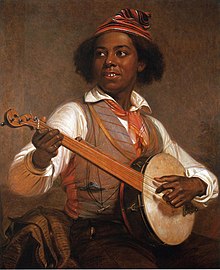
William Sidney Mount painted scenes of blackness and white American musicians. This 1856 painting depicts an African-American banjo actor.
The influence of African Americans on mainstream American music began in the 19th century, with the appearance of blackface minstrelsy. The banjo, of African origin, became a popular instrument, and its African-derived rhythms were incorporated into popular songs by Stephen Foster and other songwriters. The banjo'southward style overtime merged with European traditions such equally a flat fingerboard, and incorporating a five string neck that replaced the 3 string neck banjo in W Africa. Equally time progressed, this resulted in the creation of several different types of banjos in the United States used in music.[20]
In the 1830s, the 2d Keen Awakening led to a ascent in Christian revivals and pietism, peculiarly among African Americans. Cartoon on traditional piece of work songs, enslaved African Americans originated and began performing a wide variety of Spirituals and other Christian music. Some of these songs were coded messages of subversion confronting enslavers, or that signaled escape.
During the menstruum afterward the Civil War, the spread of African-American music continued. The Fisk University Jubilee Singers toured first in 1871. Artists including Jack Delaney helped revolutionize post-war African-American music in the central-east of the U.s.a.. In the following years, professional "jubilee" troops formed and toured. The start blackness musical-comedy troupe, Hyers Sisters Comic Opera Co., was organized in 1876.[21] In the last one-half of the 19th century, U.S. barbershops often served as customs centers, where most men would gather. Barbershop quartets originated with African-American men socializing in barbershops; they would harmonize while waiting their turn, vocalizing in spirituals, folk songs and popular songs. This generated a new way, consisting of unaccompanied, four-role, close-harmony singing. Later, white minstrel singers adopted the fashion, and in the early on days of the recording industry their performances were recorded and sold. By the end of the 19th century, African-American music was an integral part of mainstream American civilisation.
Early 20th century (1900s–1930s) [edit]

The Slayton Jubilee Singers entertain employees of the Quondam Trusty Incubator Mill, Clay Center, about 1910
In early on 20th-century American musical theater, the first musicals written and produced by African Americans debuted on Broadway in 1898 with a musical by Bob Cole and Billy Johnson. In 1901, the first recording of black musicians was of Bert Williams and George Walker, featuring music from Broadway musicals. Theodore Drury helped black artists develop in the opera field. He founded the Drury Opera Company in 1900 and, although he used a white orchestra, he featured black singers in leading roles and choruses. Although this company was only active from 1900 to 1908, black singers' opportunities with Drury marked the start black participation in opera companies. Too pregnant is Scott Joplin'southward opera Treemonisha, which is unique as a ragtime-folk opera; it was showtime performed in 1911.[22]
The early office of the 20th century saw a rise in popularity of African-American dejection and jazz. African-American music at this time was classed every bit "race music".[23] This term gained momentum due to Ralph Peer, musical director at Okeh Records, who put records made by "foreign" groups under that label. At the time "race" was a term ordinarily used by African-American press to speak of the community as a whole with an empowering signal of view, equally a person of "race" was i involved in fighting for equal rights.[24] Also, developments in the fields of visual arts and the Harlem Renaissance led to developments in music. Ragtime performers such as Scott Joplin became popular and some were associated with the Harlem Renaissance and early civil rights activists. In addition, white and Latino performers of African-American music were visible, rooted in the history of cross-cultural communication between the The states' races. African-American music was ofttimes adapted for white audiences, who would not accept as readily accepted black performers, leading to genres like swing music, a pop-based outgrowth of jazz.
In add-on, African Americans were becoming part of classical music by the turn of the 20th century. While originally excluded from major symphony orchestras, blackness musicians could study in music conservatories that had been founded in the 1860s, such equally the Oberlin Schoolhouse of Music, National Solarium of Music, and the New England Conservatory.[25] Black people too formed their own symphony orchestras at the turn of the 20th century in major cities such every bit Chicago, New Orleans, and Philadelphia. Various black orchestras began to perform regularly in the late 1890s and the early 20th century. In 1906, the first incorporated black orchestra was established in Philadelphia.[26] In the early 1910s, all-black music schools, such every bit the Music Schoolhouse Settlement for Colored and the Martin-Smith School of Music, were founded in New York.[27]
The Music Schoolhouse Settlement for Colored became a sponsor of the Clef Gild orchestra in New York. The Clef Social club Symphony Orchestra attracted both black and white audiences to concerts at Carnegie Hall from 1912 to 1915. Conducted by James Reese Europe and William H. Tyers, the orchestra included banjos, mandolins, and baritone horns. Concerts featured music written by black composers, notably Harry T. Burleigh and Will Marion Melt. Other annual black concert series include the William Hackney's "All-Colored Composers" concerts in Chicago and the Atlanta Colored Music Festivals.[28]
The return of the black musical to Broadway occurred in 1921 with Sissle and Eubie Blake'southward Shuffle Along. In 1927, a concert survey of black music was performed at Carnegie Hall including jazz, spirituals and the symphonic music of W. C. Handy's Orchestra and the Jubilee Singers. The get-go major film musical with a black bandage was Rex Vidor'due south Hallelujah of 1929. African-American performers were featured in the musical Show Boat (which had a part written for Paul Robeson and a chorus of Jubilee Singers), and peculiarly all-black operas such as Porgy and Bess and Virgil Thomson's Four Saints in Iii Acts of 1934.
The beginning symphony by a blackness composer to be performed past a major orchestra was William Grant Yet's Afro-American Symphony (1930) by the New York Philharmonic. Florence Beatrice Price's Symphony in E minor was performed in 1933 past the Chicago Symphony Orchestra.[29] In 1934, William Dawson's Negro Folk Symphony was performed by the Philadelphia Orchestra.[xxx]
African Americans were the pioneers of jazz music, through masters such as Jelly Curl Morton, James P. Johnson, Louis Armstrong, Count Basie, Fletcher Henderson, and Knuckles Ellington.
Mid-20th century (1940s–1960s) [edit]

Billboard started making a divide list of hit records for African-American music in Oct 1942 with the "Harlem Striking Parade", which was inverse in 1945 to "Race Records", and so in 1949 to "Rhythm and Blues Records".[31] [32]
By the 1940s, embrace versions of African-American songs were commonplace, and frequently topped the charts, while the original musicians constitute success among their African-American audience, but not in the mainstream. In 1955, Thurman Ruth persuaded a gospel group to sing in a secular setting, the Apollo Theater, with such success that he afterwards bundled gospel caravans that traveled around the land, playing the same venues that rhythm and blues singers had popularized. Meanwhile, jazz performers began to button jazz away from swing, danceable pop music, towards more intricate arrangements, improvisation, and technically challenging forms, culminating in the bebop of Charlie Parker and Dizzy Gillespie, the absurd sounds and modal jazz of Miles Davis, and the gratuitous jazz of Ornette Coleman and John Coltrane.
African-American musicians in the 1940s and 1950s were developing rhythm and blues into a genre called rock and roll, which featured a strong backbeat and whose prominent exponents included Louis Jordan and Wynonie Harris. However, it was with white musicians such as Bill Haley and Elvis Presley, playing a guitar-based fusion of black rock and roll with country music chosen rockabilly, that stone and roll music became commercially successful. Rock music thereafter became more associated with white people, though some black performers such as Chuck Drupe and Bo Diddley had commercial success.

Sister Rosetta Tharpe performing at Buffet Zanzibar
In 2017, National Public Radio wrote about the career of Sister Rosetta Tharpe and ended with these comments: Tharpe "was a gospel singer at heart who became a celebrity by forging a new path musically ... Through her unforgettable vocalization and gospel swing crossover mode, Tharpe influenced a generation of musicians including Aretha Franklin, Chuck Drupe and endless others ... She was, and is, an unmatched artist."[33]
As the 1940s came to a close, other African-Americans endeavored to concertize every bit professionally trained classical musicians in an effort to transcend racial and nationalistic barriers in the mail World War II era. Included in this group was Henry Lewis, who emerged in 1948 as the first African-American instrumentalist in a leading American symphony orchestra, an early "musical administrator" in support of cultural diplomacy in Europe and the first African-American conductor of a major American symphonic ensemble in 1968.[34] [35] [36] [37]
The term "rock and roll" had a strong sexual connotation in jump blues and R&B, merely when DJ Alan Freed referred to rock and roll on mainstream radio in the mid 50s, "the sexual component had been dialled down plenty that information technology simply became an acceptable term for dancing".[38]
R&B was a strong influence on Rock and roll according to many sources, including a 1985 Wall Street Journal article titled, "Stone! It's Nevertheless Rhythm and Blues". In fact, the author stated that the "two terms were used interchangeably", until nigh 1957.[39]
Fats Domino was not convinced that there was any new genre. In 1957, he said: "What they call rock 'due north' roll now is rhythm and blues. I've been playing it for 15 years in New Orleans".[forty] According to Rolling Stone, "this is a valid statement ... all Fifties rockers, blackness and white, country born and metropolis bred, were fundamentally influenced past R&B, the black popular music of the late Forties and early on Fifties".[41] Elvis Presley's recognition of the importance of artists such as Fats Domino was meaning, according to a 2017 article: the "championing of black musicians as part of a narrative that saw many positives in growing young white interest in African American-based musical styles".[42] At a printing event in 1969, Presley introduced Fats Domino, and said, "that's the existent King of Rock 'n' Roll" ... a huge influence on me when I started out".[43]
By the mid-1950s, many R&B songs were getting "covered" past white artists and the recordings got more than airplay on the mainstream radio stations. For example, "Presley quickly covered "Tutti Frutti" ...So did Pat Boone", according to New Yorker. "In 1956, lxx-six per cent of top R. & B. songs likewise fabricated the pop chart; in 1957, 80-vii per cent made the pop nautical chart; in 1958, it was xc-four per cent. The marginal market had become the main market, and the majors had got into the act."[44]
The 1950s also saw increased popularity of hard blues in the style from the earliest part of the century, both in the U.s. and United Kingdom. The 1950s likewise saw doo-wop style get popular. Doo-wop had been adult through vocal group harmony with the musical qualities of different vocal parts, nonsense syllables, little or no instrumentation, and simple lyrics. It commonly involved ensemble single artists appearing with a backing group. Solo billing was given to lead singers who were more than prominent in the musical arrangement. A secularized form of American gospel music called soul likewise developed in the mid-1950s, with pioneers such as Ray Charles,[45] Jackie Wilson and Sam Cooke leading the wave.[46] Soul and R&B became a major influence on surf, as well as the nautical chart-topping daughter groups including The Angels and The Shangri-Las, only some of whom were white. In 1959, Hank Ballard releases a vocal for the new dance way "The Twist", which became the new dance require from the early lx'south into the 70'south.[47]
In 1959, Drupe Gordy founded Motown Records, the beginning record label to primarily feature African-American artists aimed at achieving crossover success. The characterization adult an innovative—and commercially successful—mode of soul music with distinctive pop elements. Its early on roster included The Miracles, Martha and the Vandellas, Marvin Gaye, The Temptations, The Supremes, and others.[48] Black divas such as Aretha Franklin became '60s crossover stars. In the Uk, British blues became a gradually mainstream phenomenon, returning to the U.S. in the form of the British Invasion, a group of bands led past The Beatles and The Rolling Stones who performed dejection and R&B-inspired pop, with both traditional and modernized aspects. WGIV in Charlotte, Due north Carolina was amongst a few radio stations defended to African-American music that started during this menses.
The British Invasion knocked many blackness artists off the U.s. popular charts, although some, among them Otis Redding, Wilson Pickett and Aretha Franklin and a number of Motown artists, continued to practice well. Soul music, all the same, remained popular among black people through highly evolved forms such equally funk, developed out of the innovations of James Chocolate-brown.[49] In 1961, a immature boy named Stevland Hardaway Morris recorded his first tape nether Motown's Tamla record at the age of 11 as Stevie Wonder and that was the kickoff of his great career.[50]
In 1964, the Ceremonious Rights Act outlawed major forms of discrimination towards African Americans and women. As tensions started to dice down, more African-American musicians crossed over into mainstream taste. Some artists who successfully crossed over were Aretha Franklin, James Brown, and Ella Fitzgerald in the pop and jazz worlds, and Leontyne Toll and Kathleen Battle in the realm of the classical music.
By the end of the decade, Black people were function of the psychedelia and early heavy metal trends, peculiarly by way of the ubiquitous Beatles' influence and the electric guitar innovations of Jimi Hendrix.[51] Hendrix was amid the first guitarists to use audio feedback, fuzz, and other furnishings pedals such as the wah wah pedal to create a unique guitar solo audio. Psychedelic soul, a mix of psychedelic rock and soul began to flourish with the 1960s culture. Even more than popular among Black people, and with more crossover appeal, was album-oriented soul in the late 1960s and early 1970s, which revolutionized African-American music. The genre's intelligent and introspective lyrics, often with a socially enlightened tone, were created by artists such as Marvin Gaye in What's Going On, and Stevie Wonder in Songs in the Key of Life.
1970s [edit]
The 1970s was a great decade for Black bands playing melodic music. Album-oriented soul continued its popularity, while musicians such as Smokey Robinson helped turn it into Quiet Storm music. Funk evolved into ii strands, one a popular-soul-jazz-bass fusion pioneered by Sly & the Family Rock, and the other a more psychedelic fusion epitomized by George Clinton and his P-Funk ensemble. The sound of Disco evolved from black musicians creating Soul music with an up-tempo tune. Isaac Hayes, Barry White, Donna Summer and among others help popularized disco music. Yet, this music was integrated into pop music achieving mainstream success.
Blackness musicians achieved some mainstream success, though some African-American artists including The Jackson 5, Roberta Flack, Teddy Pendergrass, Dionne Warwick, Stevie Wonder, The O'Jays, Gladys Knight & the Pips constitute crossover audiences. White listeners preferred country rock, singer-songwriters, stadium rock, soft rock, glam rock, and, in some subcultures, heavy metal and punk rock. During the 1970s, The Dozens, an urban African-American tradition of using playful rhyming ridicule, adult into street jive in the early '70s, which in turn inspired a new grade of music past the late 1970s: hip-hop. Spoken-word artists such every bit The Terminal Poets, Gil Scott-Heron and Melvin Van Peebles are also cited as the major innovators in early hip-hop. Showtime at block parties in The Bronx, hip-hop music arose as ane facet of a large subculture with rebellious and progressive elements. DJs spun records, most typically funk, while MCs introduced tracks to the dancing audition. Over time, DJs, particularly Jamaican immigrant DJ Kool Herc for instance, began isolating and repeating the percussion breaks, producing a abiding, eminently danceable beat out, which they or MCs began rapping over, through rhymes and somewhen sustained lyrics.[52] Hip-hop would become a multicultural movement in young black America, led by artists such as Kurtis Accident and Run-DMC.
1980s [edit]
In the 1980s, Michael Jackson had tape-breaking success with his albums Off the Wall, Bad, and Thriller – the latter remaining the best-selling album of all time – transforming popular music and uniting races, ages and genders, and would eventually lead to successful crossover blackness solo artists, including Prince, Lionel Richie, Luther Vandross, Tina Turner, Whitney Houston, and Janet Jackson. Popular and dance-soul of this era inspired new jack swing past the end of the decade.[ citation needed ]
Hip-hop spread beyond the country and diversified. Techno, Dance, Miami bass, post-disco, Chicago house, Los Angeles hardcore and Washington, D.C. Go-get adult during this menstruum, with only Miami bass achieving mainstream success. But, before long, Miami bass was relegated primarily to the Southeastern US, while Chicago house had made stiff headways on college campuses and trip the light fantastic toe arenas (i.e. the warehouse sound, the rave). DC's Go-go garnered modest national attending with songs like E.U.'s Da Barrel, but as time went on, it proved mostly to be a regional phenomena. Chicago house audio had expanded into the Detroit music environment and mutated into more electronic and industrial sounds creating Detroit techno, acid, jungle. Mating these experimental, usually DJ-oriented, sounds with the prevalence of the multi-ethnic New York Urban center disco audio from the 1970s and 1980s created a make of music that was most appreciated in the huge discothèques that are located in cities like Chicago, New York, Los Angeles, Detroit, Boston, etc. Eventually, European audiences embraced this kind of electronic trip the light fantastic toe music with more enthusiasm than their Due north American counterparts. These variable sounds let the listeners prioritize their exposure to new music and rhythms while enjoying a gigantic dancing feel.[ citation needed ]
In the latter half of the decade, from about 1986, rap took off into the mainstream with Run-D.Yard.C.'s Raising Hell, and the Beastie Boys' Licensed to Ill, the latter becoming the outset rap album to enter the No.i Spot on the Billboard 200 and helping break down the doors for white performers to practice rap. Both of these groups mixed rap and rock together, which appealed to rock and rap audiences. Hip-hop took off from its roots and the gold age hip hop flourished, with artists such as Eric B. & Rakim, Public Enemy, LL Cool J, Queen Latifah, Large Daddy Kane, and Salt-Northward-Pepa. Hip-hop became pop in America until the late 1990s, when information technology went worldwide. The gilt age scene would dice out by the early 1990s as gangsta rap and k-funk took over, with westward-coast artists Dr. Dre, Snoop Dogg, Warren G and Ice Cube, east-coast artists Notorious B.I.G., Wu-Tang Clan, and Mobb Deep, and the sounds of urban blackness male blowing, compassion, and social awareness all-time represented by the rapper Tupac Shakur.[ commendation needed ]
While heavy metal music was near exclusively created by white performers in the 1970s and 1980s, in that location were a few exceptions. In 1988, all-black heavy metal ring Living Colour achieved mainstream success with their début anthology Vivid, peaking at No. six on the Billboard 200, thanks to their Pinnacle 20 unmarried "Cult of Personality". The ring's music contained lyrics that attack what they perceived equally the Eurocentrism and racism of America. A decade later, more black artists like Lenny Kravitz, Body Count, Ben Harper, and countless others would kickoff playing rock again.[ commendation needed ]
1990s, 2000s, and 2010s [edit]
| | This section needs to be updated. (Baronial 2021) |

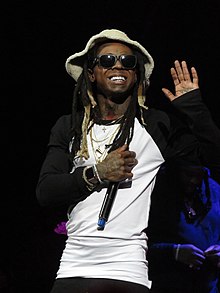
Lil Wayne is one of the elevation selling blackness American musicians in modern history. In 2008, his album sold one million in its kickoff week.
Contemporary R&B, as in the post-disco version of soul music, remained popular throughout the 1980s and 1990s. Male person song groups in the fashion of soul groups such every bit The Temptations and The O'Jays were particularly pop, including New Edition, Boyz 2 Men, Jodeci, Dru Hill, Blackstreet, and Jagged Border. Girl groups, including TLC, Destiny'due south Kid, SWV and En Vogue, were likewise highly successful.[ citation needed ]
Singer-songwriters such as R. Kelly, Mariah Carey, Montell Jordan, D'Angelo, Aaliyah and Raphael Saadiq of Tony! Toni! Toné! were also significantly popular during the 1990s, and artists including Mary J. Blige, Religion Evans, and BLACKstreet popularized a fusion alloy known equally hip-hop soul. The neo soul movement of the 1990s looked back on more classical soul influences and was popularized in the belatedly 1990s/early 2000s by such artists as D'Angelo, Erykah Badu, Maxwell, Lauryn Hill, India.Arie, Alicia Keys, Jill Scott, Angie Stone, Bilal and Musiq Soulchild. Co-ordinate to one music author, D'Angelo'south critically acclaimed album Voodoo (2000) "represents African American music at a crossroads ... To simply call [it] neo-classical soul ... would exist [to] ignore the elements of vaudeville jazz, Memphis horns, ragtime blues, funk and bass grooves, not to mention hip-hop, that skid out of every pore of these haunted songs."[53] Bluish-eyed soul is an influence of African-American music performed by Caucasian artists, including Michael McDonald, Christina Aguilera, Amy Winehouse, Robin Thicke, Michael Bolton, Jon B., Lisa Stansfield, Teena Marie, Justin Timberlake, Joss Stone, George Michael, and Anastacia.[ citation needed ]
By the first decade of the 21st century, R&B had shifted towards an emphasis on solo artists with pop appeal, with Usher, Rihanna, and Beyoncé being the most prominent examples. Furthermore, the music was accompanied by aesthetically creative and unique music videos. Examples of these types of music videos include only are not limited to: Beyoncé'southward "Crazy in Love", Rihanna's "Pon de Replay", and Usher's "Caught Up". These music videos helped R&B become more profitable and more popular than it had been in the 1990s. The line between hip-hop and R&B and pop was significantly blurred by producers such as Timbaland and Lil Jon and artists such as Missy Elliott, T-Pain, Nelly, Akon and OutKast.[ commendation needed ]
It may appear every bit though hip-hop (chosen urban music) is race-neutral today; just information technology still remains a genre of music created by African-Americans. In the early years of hip-hop, the lyrics spoke of the hardships of being black in America. White owned tape label companies controlled how hip-hop was marketed. This resulted in changes in the lyrics, culture and marketing of hip-hop to suit white audiences. Scholars of hip-hop and African-American hip-hop creators noticed a change in hip-hop over the years as white owned record label companies controlled how hip-hop is marketed to whites. Hip-hop is used to sell cars, cell phones, and other trade.[54] [55]

Edward Ray at Capitol Records
The hip-hop motion has become increasingly mainstream as the music industry has taken command of information technology. Substantially, "from the moment 'Rapper'southward Delight' went platinum, hiphop the folk culture became hiphop the American amusement-industry sideshow."[56]

l Cent in 2006. 50 Cent was one of the most popular African-American rappers of the 2000s.
In the early 2000s, l Cent was ane of the most popular African-American artists. In 2005, African-American rapper 50 Cent's album The Massacre sold more than a meg anthology copies in its outset calendar week. In 2008, Lil Wayne's album Tha Carter 3 sold more than a one thousand thousand copies in its first week also.[57]
In June 2009, Michael Jackson died unexpectedly from a cardiac arrest, triggering a global outpouring of grief. Within a yr of his death, his estate had generated $i.4 billion in revenues. A documentary movie consisting of rehearsal footage for Jackson's scheduled This Is It tour, entitled Michael Jackson's This Is Information technology, was released on October 28, 2009, and became the highest-grossing concert film in history.[58]
In 2013, no African-American musician had a Billboard Hot 100 number one. This was the beginning time in that location was no number 1 in a year past an African American in the nautical chart's 55-year history.[59]
Plans for a Smithsonian-affiliated Museum of African-American music to be built in Newark, New Jersey, and an R&B museum/hall of fame have been discussed.[ citation needed ]
Blackness protestation music went mainstream in the 2010s.[60] Beyoncé, Solange, Kanye West, Frank Body of water, and Rihanna released black protest albums during Donald Trump'southward candidacy. Beyoncé released her get-go blackness protest album Lemonade in 2016.
In the late 2010s, mumble rap which originated from African-American Vernacular English became popular with artists like Playboi Carti.[61] [62]
Economic touch on [edit]
Tape stores played a vital role in African-American communities for many decades. In the 1960s and 1970s, between 500 and 1,000 black-owned record stores operated in the American South, and probably twice as many in the United States as a whole. African-American entrepreneurs embraced record stores every bit key vehicles for economic empowerment and disquisitional public spaces for black consumers at a time that many black-endemic businesses were endmost amid desegregation.[63] In addition, countless African Americans have earned livings as musical performers, club owners, radio deejays, concert promoters, and tape label owners. Many consumer companies use African American music to sell their products. Companies similar; Coca-Cola, Nike, and Pepsi have used artists to sell to the youth and other followers of the genres.[64] A prime example of the economic impact that African-American music is the way the NFL exposes new and old music with its super bowl halftime show.
International influence [edit]
The genres of Jazz and Hip-Hop spread around the world. These genres traveled to Africa and Asia and influenced other genres of African and Asian Music.[65] The textural styles, slang linguistic communication and African American Vernacular English influenced American pop culture and global culture. The way African-Americans apparel in hip-hop videos and how African-Americans talk is copied for style and profit in the American market and the global market.[66] [67] Blues, jazz, and hip-hop were created in African-American neighborhoods despite African-Americans are marginalized in American society on an economic and social level, the music created past African-Americans had a global bear on due to marketing and media.[68] With the advent of the net, African-American music and culture has become consumed more speedily effectually the world on a daily basis. The net resulted in the mass consumption and appropriation and sometimes mocking of black civilisation by whites and non-blacks in social media.[69]
Afrobeat [edit]
Afrobeat is a West African genre of music created by Nigerian artist Fela Kuti. Kuti created Afrobeat fusing traditional West African music with African-American music of Jazz, R&B, and other genres of West African and African-American music.[70] West African musicians fused African-American music with their traditional West African music creating new genres of music. In improver, funk music also influenced Afrobeat. James Brown's Funk music, Chocolate-brown's dance fashion and African-American drumming influenced Afrobeat.[71] In London, Kuti joined jazz and rock bands, and when he returned to Nigeria the creation of Afrobeat began in the country by fusing African-American and traditional Yoruba music. In 1969, Kuti toured the The states. Through his travels, Kuti became inspired by the political activism of African Americans. Kuti studied the life of Malcolm X and was inspired by his pro-black speeches. This resulted in a change in Kuti's bulletin in Afrobeat as it became more than political discussing the political issues in Africa and Nigeria.[72]
K-pop music [edit]
Hip-hop came to Korea in the 1990s. Information technology later developed into a genre of hip-hop in Korea called Korean Hip-Hop and Korean 1000-pop music.[73] Although African-American music influenced genres of Korean pop music and culture, some Korean artists are known to appropriate African-American vernacular and other aspects of Black civilisation.[74] [75]
See also [edit]
- African-American dance
- African American musical theater
- Groove
- Afro-Caribbean music
- Blackface
- Cultural appropriation
- Gandy dancer
- Juke joint
- Listing of musical genres of the African diaspora
- Music of the African diaspora
- National Museum of African American Music
- Music of Africa
- Music of the United States
- Creole music
- Romani music
- Mexican music
References [edit]
- ^ Smithsonian Staff. "Slave Shout Songs from the Declension of Georgia The McIntosh County Shouters". Smithsonian Folkways Recordings. Smithsonian Institution. Retrieved May 23, 2021.
- ^ Mcmanus, Melanie (May 27, 2021). "Dancing at the new National Museum of African American Music in Nashville". Chicago Tribune. Retrieved Dec 13, 2021.
- ^ Eaglin, Maya (February 21, 2021). "The soundtrack of history: How Black music has shaped American culture through time". NBC News. NBC News. Retrieved December 17, 2021.
- ^ Sullivan, Megan. "African-American Music as Rebellion: From Slavesong to Hip-Hop" (PDF). pp. 21–39.
- ^ Samuel, Floyd (1996). The Power of Blackness Music Interpreting Its History from Africa to the United States. Oxford University Printing. p. 208. ISBN978-0-19-510975-7.
- ^ Price, Tanya (2013). "Rhythms of Civilisation: Djembe and African Memory in African-American Cultural Traditions". Blackness Music Enquiry Journal. 33 (2): 227–247. doi:10.5406/blacmusiresej.33.ii.0227. JSTOR x.5406/blacmusiresej.33.2.0227. S2CID 191599752.
- ^ Wilson, Olly (1974). "The Significance of the Relationship between Afro-American Music and Westward African Music". The Black Perspective in Music. 2 (1): 6. doi:10.2307/1214144. JSTOR 1214144.
- ^ "National Museum of African American Music". Retrieved May 28, 2021.
- ^ Mcmanus, Melanie (May 27, 2021). "Dancing at the new National Museum of African American Music in Nashville". Chicago Tribune. Retrieved May 28, 2021.
- ^ Smithsonian Staff. "Roots of African American Music". Smithsonian Music. Smithsonian Institution. Retrieved December 21, 2021.
- ^ Stewart 1998, pp. five–fifteen.
- ^ Blassingame, John (1980). The slave community. Oxford University Press. p. 138. ISBN978-0-19-502563-7.
- ^ Twining, Mary Arnold (1985). "Motility and Trip the light fantastic toe on the Bounding main Islands". Periodical of Blackness Studies. 15 (4): 471. doi:10.1177/002193478501500407. JSTOR 2784212. S2CID 143507385.
- ^ Larson, Kate (2009). Bound for the Promised Land Harriet Tubman: Portrait of an American Hero. Random Business firm Publishing Group. pp. 82–83, 101, 187–188. ISBN9780307514769.
- ^ UN Staff. "Drums and Slavery". Department of Public Data, Un. United nations. Retrieved Dec 18, 2021.
- ^ NPS Staff. "Performing Culture in Music & Dance". African American Heritage & Ethnography. National Park Service. Retrieved Dec eighteen, 2021.
- ^ Holloway, Joseph Due east. (March 3, 2019). Africanisms in American Culture. Indiana University Printing. ISBN978-0253217493. [ folio needed ]
- ^ Maultsby, Portia. "A History of African American Music". Archived from the original on July 14, 2012. Retrieved August 14, 2012.
- ^ Smithsonian Staff. "Slave Shout Songs from the Declension of Georgia The McIntosh County Shouters". Smithsonian Folkways Recordings. Smithsonian Institution.
- ^ Smithsonian Staff. "How has the Banjo Changed Over Fourth dimension?". Smithsonian Folkways Recordings. Smithsonian Music. Retrieved Dec 20, 2021.
- ^ Southern 221.
- ^ Southern 221-2, 294.
- ^ "Race Music". St. James Encyclopedia of Popular Culture past Matthew A. Killmeier 01/29/02. 2002.
- ^ Brackett, David. The Pop, Rock and Soul Reader.
- ^ Southern 266.
- ^ Southern 291.
- ^ Southern 288-9.
- ^ Southern 285, 292.
- ^ "American Symphony Orchestra – Symphony No. 1 in E minor (1932)". americansymphony.org.
- ^ Southern 361.
- ^ "The Elvic Oracle Did anyone invent rock and coil?". New Yorker. November 16, 2015. Retrieved February 22, 2021.
pop, state-and-Western, and (a new term, replacing "race music") rhythm and blues.
- ^ Bronson, Fred (June 12, 1993). "Songs, soul and fusion stage a comeback as A&R hops aboard the '70s love railroad train". Billboard. Vol. 105, no. 24. Nielsen Business Media. p. 47. Retrieved July 17, 2011.
- ^ "Forebears: Sister Rosetta Tharpe, The Godmother Of Rock 'Due north' Ringlet". NPR. August 24, 2017. Retrieved February 22, 2021.
- ^ Appiah, Kwame Anthony (2005). Africana – The Encyclopedia of the African & African American Experience. Oxford University Press. p. 563. ISBN978-0195170559.
- ^ Brownish, Emily Freeman (2015). A Dictionary for the Mod Conductor. Scarecrow Printing. pp. 197, 211, 240, 311. ISBN978-0-8108-8401-4.
- ^ New Music New Allies Amy C. Beal, Academy of California Printing, Berkeley, 2006, P. 49, ISBN 9780-520-24755-0 "7th Regular army Symphony Orchestra (1952–1962) performing works by Roy Harris, Morton Gould and Leroy Anderson" on https://books.google.com
- ^ Seventh Army Symphony Orchestra – praised throughout Europe on https://books.google.com
- ^ "The unexpected origins of music's nigh well-used terms". BBC. Oct 12, 2018. Retrieved February 22, 2021.
its significant roofing both sex and dancing
- ^ Redd, Lawrence N. (March one, 1985). "The Black Perspective in Music". Wall Street Journal. thirteen (1): 31–47. doi:10.2307/1214792. JSTOR 1214792.
- ^ Leight, Elias (October 26, 2017). "Paul McCartney Remembers 'Truly Magnificent' Fats Domino". Rollingstone.com . Retrieved March xv, 2021.
- ^ Palmer, Robert (April 19, 1990). "The 50s: A Decade of Music That Changed the World". Rollingstone.com . Retrieved March xv, 2021.
- ^ "Champion or copycat? Elvis Presley's cryptic human relationship with black America". The Conversation. August fourteen, 2017. Retrieved March xv, 2021.
- ^ "Remembering Fats Domino: The Beatles, Elvis Presley and the real king of rock 'n' roll". National Mail. October 26, 2017. Retrieved March xv, 2021.
ut stone 'northward' roll was here a long time before I came along. Let'southward face information technology: I can't sing like Fats Domino tin can. I know that."
- ^ "The Elvic Oracle Did anyone invent stone and roll?". New Yorker. Nov xvi, 2015. Retrieved February 22, 2021.
- ^ Ray Charles interviewed on the Popular Chronicles (1969)
- ^ Gilliland, John (1969). "Show 17 – The Soul Reformation: More on the evolution of rhythm and blues. [Part 3]" (audio). Popular Chronicles. Academy of N Texas Libraries.
- ^ "African American Song". Library of Congress . Retrieved February 25, 2019.
- ^ Motown artists interviewed on the Pop Chronicles (1969)
- ^ "Soul Reformation" artists interviewed on the Pop Chronicles (1970)
- ^ "African American Song". Library of Congress . Retrieved February 22, 2019.
- ^ Gilliland, John (1969). "Show 53 – Cord Homo" (sound). Pop Chronicles. University of Due north Texas Libraries.
- ^ "THE ROOTS OF HIP HOP – RM HIP HOP MAGAZINE 1986". Globaldarkness.com. Retrieved June 23, 2012.
- ^ "Review of Voodoo". NME: 42. Feb xiv, 2000.
- ^ Kopano, T. Brown (2014). Soul Thieves The Appropriation and Misrepresentation of African American Popular Culture. Palgrave Macmillan. pp. 9–ten, 35–40. ISBN9781137071392.
- ^ Blackshear, Janise Marie (2007). Agreement the White, mainstream appeal of hip-hop music: is it a fad or is it the real thing? (PDF) (Thesis). OCLC 319404361.
- ^ Tate, Greg (January 4, 2005). "Hip-hop Turns thirty: Whatcha Celebratin' For?", Village Vocalism.
- ^ Seabrook III, Robby (March 3, 2020). "Here Are the Biggest Commencement-Calendar week Hip-Hop Album Sales over the Years". XXL.
- ^ "Michael Jackson'south wealth soars later decease". Retrieved Feb seven, 2014.
- ^ "Color Blind: No African-American Artists Had a No. one Hit in 2013". Time. January 10, 2014. Retrieved January 21, 2014.
- ^ Corry, Kristin (November 11, 2019). "The 2010s Were the Decade when Black Protestation Music Went Mainstream". Vice.
- ^ Rossen, B. (July 4, 2018). The part of emotion in AAVE pronunciation: Grumble Rap as a phenomenon of Linguistic communication Evolution (Thesis). hdl:123456789/6154.
- ^ Drew, Ashley (April 1, 2019). Changes in Hip-Hop: A Look at 'Mumble Rap' (Thesis).
- ^ Joshua Clark Davis, "For the Records: How African American Consumers and Music Retailers Created Commercial Public Space in the 1960s and 1970s South," Southern Cultures, Winter 2011.
- ^ Blair, M. Elizabeth; Hatala, Mark North. (1992). "The Utilise of Rap Music in Children's Advertising". ACR Due north American Advances. NA-19.
- ^ Nettle, Bruno (2016). Excursions in World Music, 7th Edition. Taylor and Francis. ISBN9781317213741. [ page needed ]
- ^ Keyes, Cheryl (2003). "The Artful Significance of African American Sound Culture and Its Bear upon on American Popular Music Style and Industry". The Globe of Music. 45 (3): 105–129. JSTOR 41699526.
- ^ Kopano, T. Brown (2014). Soul Thieves The Cribbing and Misrepresentation of African American Popular Culture. Palgrave Macmallin. pp. 35, 41, 58. ISBN9781137071392.
- ^ Salaam, Kalamu (1995). "It Didn't Jes Grew: The Social and Artful Significance of African American Music". African American Review. 29 (2): 351–375. doi:10.2307/3042315. JSTOR 3042315.
- ^ Drake, Simone; Henderson, Dwan (2020). Are You Entertained? Blackness Pop Culture in the Twenty-Commencement Century. Duke University Press. ISBN9781478006787.
- ^ Sturman, Janet, ed. (2019). The SAGE International Encyclopedia of Music and Culture. Sage Publications. ISBN9781506353371. [ folio needed ]
- ^ Stewart, Alexander (2013). "Go far Funky: Fela Kuti, James Brown and the Invention of Afrobeat". American Studies. 52 (4): 101–108. doi:10.1353/ams.2013.0124. JSTOR 24589271. S2CID 145682238.
- ^ "Fela Kuti Nigerian musician and activist". Encyclopedia Britannica . Retrieved December 20, 2021.
- ^ Anderson, Crystal (2020). Soul in Seoul African American Popular Music and K-pop. University Press of Mississippi. ISBN9781496830111. [ page needed ]
- ^ Gardner, Hyniea. "The Impact of African-American Musicianship on South Korean Popular Music: Adoption, Appropriation, Hybridization, Integration, or Other?" (PDF). Main's Thesis (Harvard Extension Schoolhouse). Retrieved December 17, 2021.
- ^ Joyce, Mickaela (February viii, 2021). "Black Voices: Chiliad-pop is influenced past Black culture, simply lacks Black representation". Indiana Daily Student. Indiana Academy. Retrieved Dec 20, 2021.
Sources [edit]
- Southern, Eileen (1997). The Music of Black Americans: A History. Due west. Westward. Norton & Company; 3rd edition. ISBN 0-393-97141-4
- Stewart, Earl L. (1998). African American Music: An Introduction. ISBN 0-02-860294-3.
- Cobb, Charles E., Jr., "Traveling the Blues Highway", National Geographic Magazine, Apr 1999, 5. 195, n.4
- Dixon, RMW & Godrich, J (1981), Blues and Gospel Records: 1902–1943, Storyville, London.
- Hamilton, Marybeth: In Search of the Blues.
- Leadbitter, Thousand., & Slaven, N. (1968), Dejection Records 1943–1966, Oak Publications, London.
- Ferris, William; Requite My Poor Heart Ease: Voices of the Mississippi Blues, University of N Carolina Press (2009). ISBN 0-8078-3325-eight ISBN 978-0807833254 (with CD and DVD)
- Ferris, William; Glenn Hinson, The New Encyclopedia of Southern Culture: Volume 14: Folklife, University of Due north Carolina Printing (2009). ISBN 0-8078-3346-0 ISBN 978-0-8078-3346-9 (Encompass :photo of James Son Thomas)
- Ferris, William; Blues From The Delta, Da Capo Press; revised edition (1988). ISBN 0-306-80327-5 ISBN 978-0306803277
- Gioia, Ted; Delta Blues: The Life and Times of the Mississippi Masters Who Revolutionized American Music, W. W. Norton & Visitor (2009). ISBN 0-393-33750-2 ISBN 978-0393337501
- Harris, Sheldon; Dejection Who'south Who, Da Capo Press, 1979.
- Nicholson, Robert; Mississippi Blues Today! Da Capo Printing (1999). ISBN 0-306-80883-viii ISBN 978-0-306-80883-8
- Palmer, Robert; Deep Blues: A Musical and Cultural History of the Mississippi Delta, Penguin reprint (1982). ISBN 0-14-006223-8; ISBN 978-0-xiv-006223-6
- Ramsey Jr, Frederic; Been Here And Gone, 1st edition (1960), Rutgers University Press; London Cassell (U.k.) and New Brunswick, NJ. 2nd printing (1969), Rutgers University Press, New Brunswick, NJ: Academy Of Georgia Press, 2000.
- Wilson, Charles Reagan, William Ferris, Ann J. Adadie, Encyclopedia of Southern Culture (1656 pp.), Academy of North Carolina Press; 2nd edition (1989). ISBN 0-8078-1823-2. ISBN 978-0-8078-1823-7
Further reading [edit]
- Joshua Clark Davis, "For the Records: How African American Consumers and Music Retailers Created Commercial Public Infinite in the 1960s and 1970s South," Southern Cultures, Winter 2011.
- Work, John Due west., compiler (1940), American Negro Songs and Spirituals: a Comprehensive Collection of 230 Folk Songs, Religious and Secular, with a Foreword. Bonanza Books, New York. North.B.: Consists near notably of an analytical study of this repertory, on p. one–46, an anthology of such music (words with the notated music, harmonized), on pp. 47–250, and a bibliography, on p. 252–256.
External links [edit]
- https://folklife.si.edu/magazine/freedom-sounds-tell-it-like-it-is-a-history-of-rhythm-and-dejection
- https://www.loc.gov/collections/songs-of-america/manufactures-and-essays/musical-styles/ritual-and-worship/african-american-gospel
- https://www.loc.gov/item/ihas.200197383
- https://www.loc.gov/audio/?q=Negro+spirituals
- https://world wide web.loc.gov/item/ihas.200197451
- Shall We Gather at the River, a collection of African-American sacred music, made available for public use by the State Archives of Florida
- 20 historical milestones in African-American music
- . New International Encyclopedia. 1905.
- History of African music
Source: https://en.wikipedia.org/wiki/African-American_music
0 Response to "True or False Unlike Art Music Americas Pop Music Sustains a Mass Appeal"
Post a Comment